Hand made, small batch, since day one

Bread shaped by hand, baked with a purpose.

Small Bites is a bakery growing from a single seed, our idea: traditional technique and true ingredients, respected and unhurried, make for better bread — bread that should also be good for the people and the place around it.

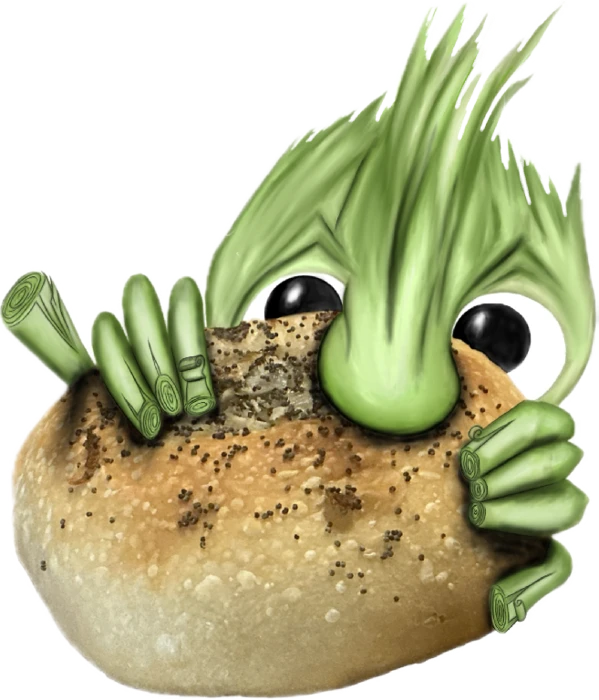
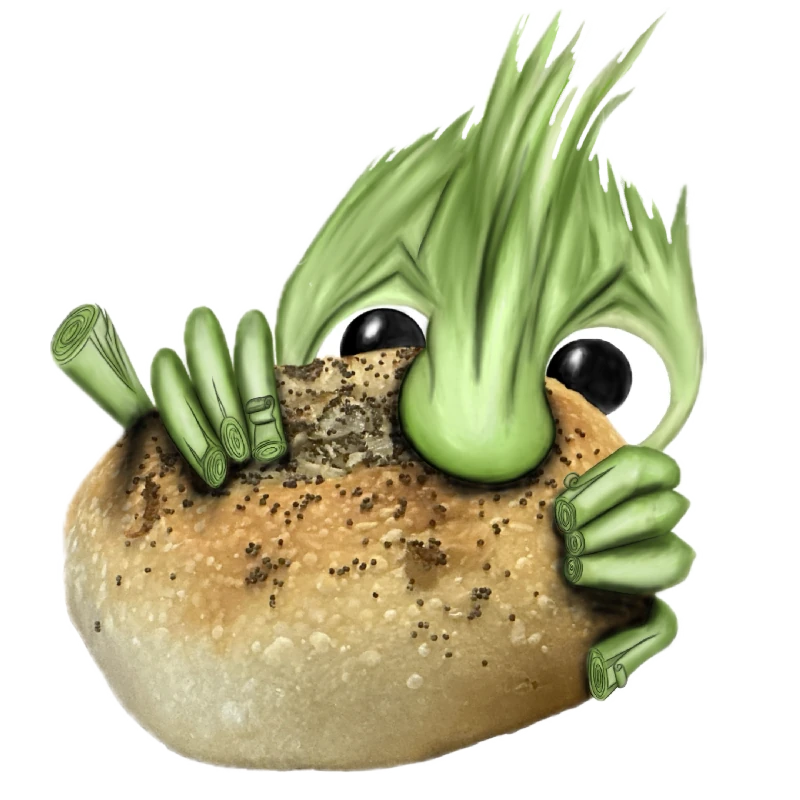
Small Bites' illustrated mascot, a leek peeking over a fresh bialy
Why Small Bites?

Small Bites, because nothing worth doing gets done all at once — a lesson we've worked to teach our children when they faced the apparently impossible: "Don't try to swallow the whole cookie at once." Big tasks, small businesses, grand ambitions — they all go down easier one Small Bite at a time.

Why we bake this way

Slow food, made by hand, for the people close to us.

Every bread we make starts the same way our forbears started theirs: mixed and shaped by hand using traditional tools and technique, all while giving the dough the time it needs to develop and proof, with no shortcuts taken that would compromise our promise of quality. We believe good bread is built by adherence to long-established tradition through small, daily acts — each one a sort of devotion — caring for the people who share our bread, the community that sustains itself — and in sustaining itself, supports us — and the planet that supports us all.

Traditional technique

Made by hand, then allowed to proof slowly, the way bialys have been made for generations — no shortcuts, no additives to fake the texture time gives for free.

Community, first

We bake for our neighbors, sell through our local grocer, and keep our batches small enough to stay close to the people we're feeding.

Environment & wellbeing

Thoughtful sourcing, simple but premium ingredients, and packaging that's already mostly plant-based and compostable — with fully compostable within reach in the near future. Good for people means good for the places they live as well.

Who's behind it

Jon the baker. Kristina the fixer. While he is in the kitchen making sure this batch comes out right, she is watching the nuts and bolts — compliance, legal, accounting, the parts nobody else sees and poor Jonathan can't wrap his head around. All of this is squeezed in around a full-time job that has nothing to do with bread, or not the edible sort anyway. They met, years ago, working the day shift at a restaurant they would both rather forget — Jon sweating and swearing in the kitchen, Kristina holding her own in the dining room, while working two jobs and putting herself through school. She'll jump in and manage a bialy now and then, but don't let her tell you she's a baker — that's Jon's department.

Where it comes from

A bread carried across a diaspora.

The bialy takes its name from Białystok, a city in northeastern Poland that was, for generations, home to a large and thriving Jewish community. Locally it was simply "kuchen from Bialystok" — an everyday bread, baked in small kitchens and sold from ordinary storefronts across the city.

Waves of emigration, driven by pogroms and hardship, but also by hope for a better life in the burgeoning cities of the New World, carried Bialystokers and their baking traditions abroad. By the early 1900s, immigrant bakers were making them in New York's Lower East Side, where the name shortened to "bialy" and the bread found a second home.

The unfathomable loss of life, light and culture that devastated so many communities during World War Two took its toll on Bialystok, Poland and its bialy-baking tradition, which all but disappeared from the city that gave the bread its name. What survived then, what still survives today, does so because immigrants and their descendants kept baking, far from where it began. Today the bialy could be called a truly American bread, but it is important to us that we remember and respect its history and its place in the human tapestry. As descendants of European immigrants, indeed as immigrants ourselves, we feel that story adds real value to the bread that we love.

It's a distinction worth making: the bialy wasn't invented in New York. It was born in Białystok, and New York is simply where it kept being made after there was no home, in the old country, left to make it in. Today we are baking our beloved bialys in Kittery, Maine because that is where the currents of our own diasporas have brought us, a first-generation immigrant and a third-generation child of immigrants. Everything that matters most hasn't happened yet, but how can we know what truly matters if we forget where we came from?

We think about that history every time we mix and shape our breads by hand, using nearly the same tools and all the same techniques as the first to make them; we remember where we are from every time we watch a loaf blossom on the hearth, blooming into a beautiful, blistered, crispy-brown double handful: food can, and maybe even should, carry a place and its people forward long after everything else has changed, after the names and faces of the first have faded from memory — and that is why tradition and technique matter so much to us, why we know we won't be the last.

Białystok, Poland

An everyday bread

Baked in home kitchens and small bakeries across a city with deep Jewish roots.

Early 1900s — Lower East Side, NY

Carried by immigrants

Emigration brought Bialystokers, and their baking, to New York — where "bialy" got its name.

Today

Small Bites

We keep shaping them the same way by hand, and carry the story forward with every batch.

Now and then

Small Blogs Maine.

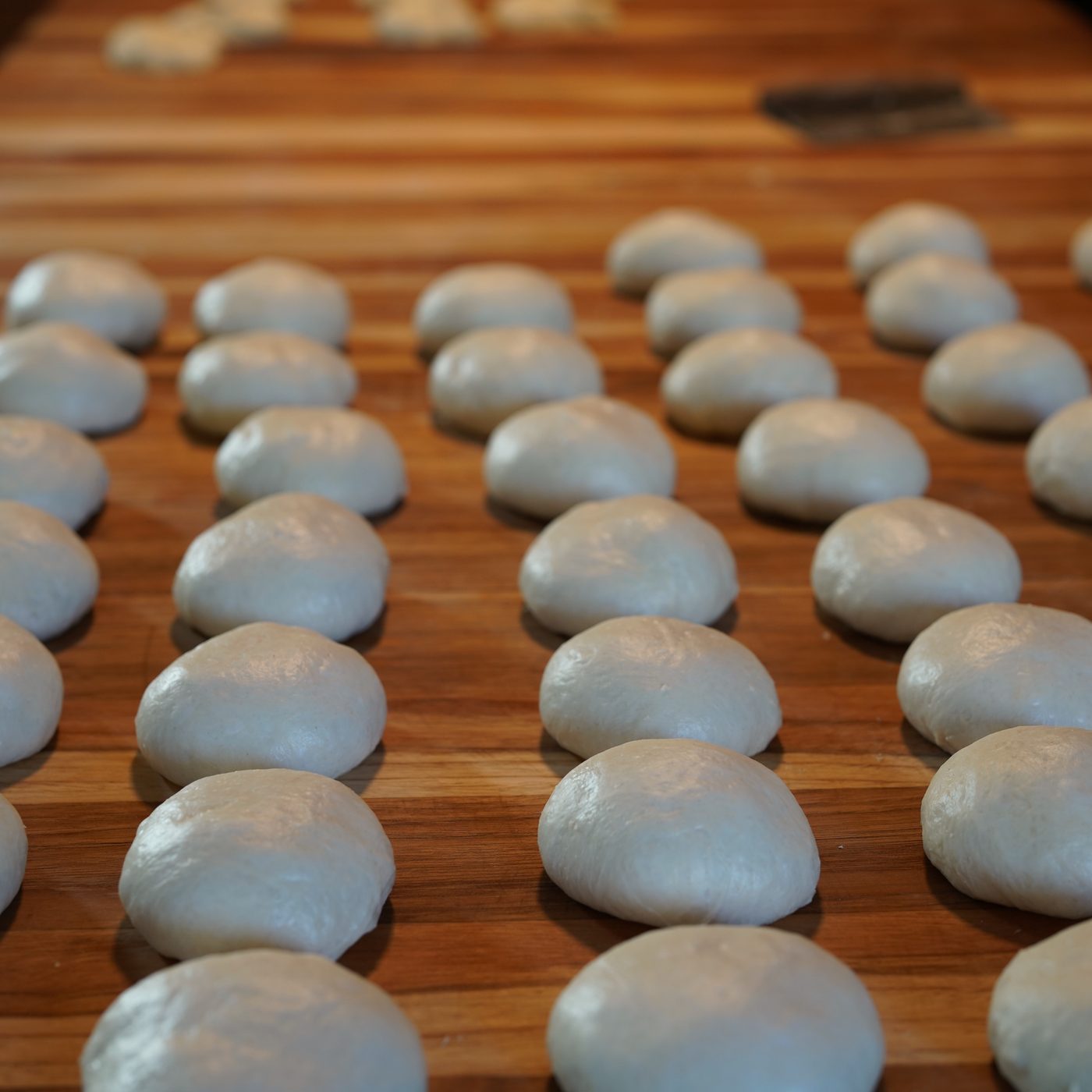
Rows of smooth, pale dough balls resting on a striped wooden butcher-block bench, a bench scraper and more dough out of focus at the far end.

Lately I find myself traveling in new circles.

I mean, people are always going in circles, aren’t they?

Don’t get me wrong, though: this is not a rant — nor is it my intention to write a blog post dedicated to trite clichés about the human condition — this is about bread and baking and about the last several weeks of my own journey…

The first four weeks of the Small Bites baking company.

The thing about circles is they don’t have to be a rut: some loops satisfy reliably, repetitively, like a favorite walk, a beloved book reread, or another filling, and fulfilling, iteration of a proven recipe.

Some loops prove their value through the very act of return, the way a sweater grows incrementally from the endless circles within circles of a crochet hook in clever hands, or the way a sourdough starter gets better, stronger and more flavorful when used with regularity.

Great bread is not produced by chance, or inspiration; it is not a spur-of-the-moment sort of thing. Bread requires planning, preparation, the careful application of ancient techniques — often at the expense of sleep. One does not become a baker because they are prone to waking up before 4 a.m.; one learns to wake up, and get to work, before dawn, when normal humans are still abed, because they have become a baker.

The first time it happened to me — becoming a baker, I mean — I was in my early twenties. Already far enough into my career as a foot soldier in the trenches of the local restaurant scene to be feeling more than a little jaded at the prospects, or lack thereof, presented by a string of future jobs that — if past performance was any predictor — seemed likely to lean heavily into dish pits, sandwich stations, brunch shifts and other forms of persistent personal torture.

At a relative’s suggestion I answered a classified ad looking for help at a local mid-sized bakery supplying several cafés of its own, plus a handful of wholesale accounts. I had zero hands-on-bread time going into the interview, but the owner must have seen something in me because he let me into the club; I got a well-worn apron, a bench knife, some interesting new friends and an introduction to a world that would soon consume me entirely, like a healthy culture consumes the slurry of flour and water it is fed three or four times a day.

I became deeply invested in bread; those unfortunate enough to be in my circle at that time can attest that I would not shut up about bread. Bread bread bread. Maybe you know someone… Do try to be gentle; we are harmless, after all, pie-eyed acolytes of the cult of culture, and we just… we just want to talk to you about sourdough some more…

I read all the books, I threw all sorts of things into the big spiral-arm mixers that were just a small sample of the many wonderful industrial-sized toys that I got to play with at my new job, I pulled thousands of loaves out of several marvelously huge ovens — it was hard work, but it was deeply satisfying in a way that I had not encountered before in a j-o-b — a true indicator of a thread that has wound its way through the story of both my professional and private life in the decades since: I have been all sorts of things, done all kinds of jobs, but I have always been a baker.

Today I find myself looking back at four full weeks of the latest chapter in that story, the first four weeks of our newborn business: a micro-bakery operating under a cottage license out of our own kitchen, only slightly modified to accommodate the very real demands of our six-day-a-week production schedule.

It is a Monday, and so I did not start this day as I do all of the other ones, stumbling out of bed well before dawn to blearily bake the first of four or five rounds of breads, like that mustachioed legend of TV lore: “Time to make the… bialys!”

Ha.

Betty has had her first big feeding of the day, a sizable slurry slowly bubbling in a covered bowl on the bench. A smaller amount of freshly fed starter left in her large, covered glass jar to start the next stitch in the row.

Soon I will head over to the Golden Harvest to pick up any of yesterday’s product that might still be left. Rather than sell day-old breads or risk anyone having a less-than-best experience of our offerings, I have been bringing anything we didn’t sell to the community fridge at the Kittery Community Center, where I believe it finds its way to people who need it. I cannot bear throwing away food and would have a very hard time continuing to do business if food waste were part of the model.

Then, this afternoon, big-Betty-in-the-bowl gets built up further still, the remaining ingredients incorporated, not at all gently, by hand in a wrestling match between baker, bench and bowl, the resulting dough coddled and covered between occasional rounds of further smacking around until tray upon tray of smooth little lumps are finally stacked in the fridge awaiting final fillings and the next morning’s bake. The Betty-that-will-be, meanwhile, gets another feeding at the end of the day, ensuring that what is in the covered jar waiting for me the next morning will be a proper preferment, the foundation of another day’s dough.

The morning is the most tightly packed and busiest-feeling part of our day: several rounds of bialys, nahlys and larger loaves get baked and cooled, labels have to be printed and cut to size, all items packaged and labeled according to code and the result delivered to the market and on the shelves before they open. That is the goal, anyway; some days — like yesterday, with its overnight power failure — we get there a bit late.

Fresh bread delivered, we gather what is left from the previous day’s offerings and bring them to the community fridge before returning home to pour Betty from her jar and into the bowl where the next stitch in the chain gets its start.

I am a little tired, it’s true. All jokes aside, I sympathize completely with old Fred and his demanding — and not very restful — doughnut schedule.

But I think I can tell you why Fred lurched out of bed at an unfortunate hour, over and over, morning after morning, in an exhausted and seemingly endless loop.

Done right, with respectful attention to detail and all the stops along the way that anchor us to generation upon generation of bakers who have come before us, this is a craft that offers a path to enough-ness. I see in our beginnings here at Small Bites a real chance at a satisfying career, an ethical and useful occupation.

It is a good loop, each day a solid link in a carefully crafted chain, each bleary-eyed morning the beginning of the next stitch…

If we keep at this long enough, who knows what we might make?
Earlier entries
Entry 1 · September 4, 2026
Two yellow poppies on a slender stem, petals open, against a soft out-of-focus background of dark green foliage with three more yellow blooms blurred behind them.

I have been a part of the Seacoast community for forty-plus years, since my family moved to Dover when I was in middle school, and I have proudly called myself a Kittery resident for the last twenty-five years, give or take. Not even close to local status according to the rules (real Mainers aren’t even sure if my kids belong in their club, never mind that they were both born in York Hospital) but I have been around here for a while. Long enough to get to know the map.

Long enough to occasionally slip and call the grocery store in Portsmouth the “Pic ’n Pay” anyway!

A lot of personal history is written into that map, my own journeys, missions accomplished and abandoned, friends lost and found… I have worked more than a handful of jobs in area restaurants and bakeries, laboring alongside many other members of the greater Seacoast family — some of whom I still pass on the streets to this day, a nod or a “sup?” the only acknowledgment of shared history, some of which history we might even, vaguely, remember.

The water under the bridge can get pretty murky at times.

But wherever I have drifted in the decades I have spent here, there have been a few longstanding landmarks, and of those only the rarest can claim to have stood the entire time, nearly unchanged, the truest of anchors in a sea of change, still intrinsically themselves despite the endless construction and progress all around.

The Golden Harvest has always been there, and (although I know that it has changed a bit over the decades) it has changed so slowly as to feel almost frozen in time. This is not a criticism — far from it — this is a love letter to a place that has been a part of my life as long as I can remember. A place that I visit several times a week not just because I love the produce and other products on sale there but because I love the place, the look, the feel of it, the creak of its boards under our feet.

And now that great, good place is letting us stock our humble breads and giving us an amazing opportunity to put our offerings before the people we baked them for: our neighbors in Kittery and our greater Seacoast family… we are so very grateful. Thank you to Julianna, John and the entire Golden Harvest/Carl’s family. We will endeavor always to live up to the honor.

Long may your harvests be golden.

What we bake

Bialys first. Then whatever Betty's up for.

Meet Betty, our sourdough starter

Every bread we bake begins with Betty — our sourdough culture, over ten years old, born in San Francisco, and living in coastal Maine ever since. A starter is a living community of wild yeast and bacteria, and over years it settles into wherever it's kept, picking up subtle traits from the local air and flour. That character, developed with time and care, is a big part of what gives our bread its flavor — a taste that couldn't come from anywhere else. Betty earned her name the way many of the things around here do — a quirky sense of humor coupled with a belief in the value of connection, even with the inanimate (or, in Betty's case, the very animated result of a symbiotic relationship between wild yeast and bacteria in active fermentation). Betty is a real beauty.

What goes in the dough
  • Extra virgin olive oil For flavor and a tender crumb.
  • Filtered water Filtered by reverse osmosis for a clean, consistent base.
  • Unbleached flour Left as milled, without chemical whitening.
  • Iodine-free sea salt A simple, mineral salt with nothing added.

Plus a small amount of sugar. Our Bialys, Nahlys, Whimsy, Skally and Big Sammy all start from this dough. Serious Balt is a dough of its own — rye-led, with malt and cacao — and its ingredients are on its label, as are all fillings and toppings.

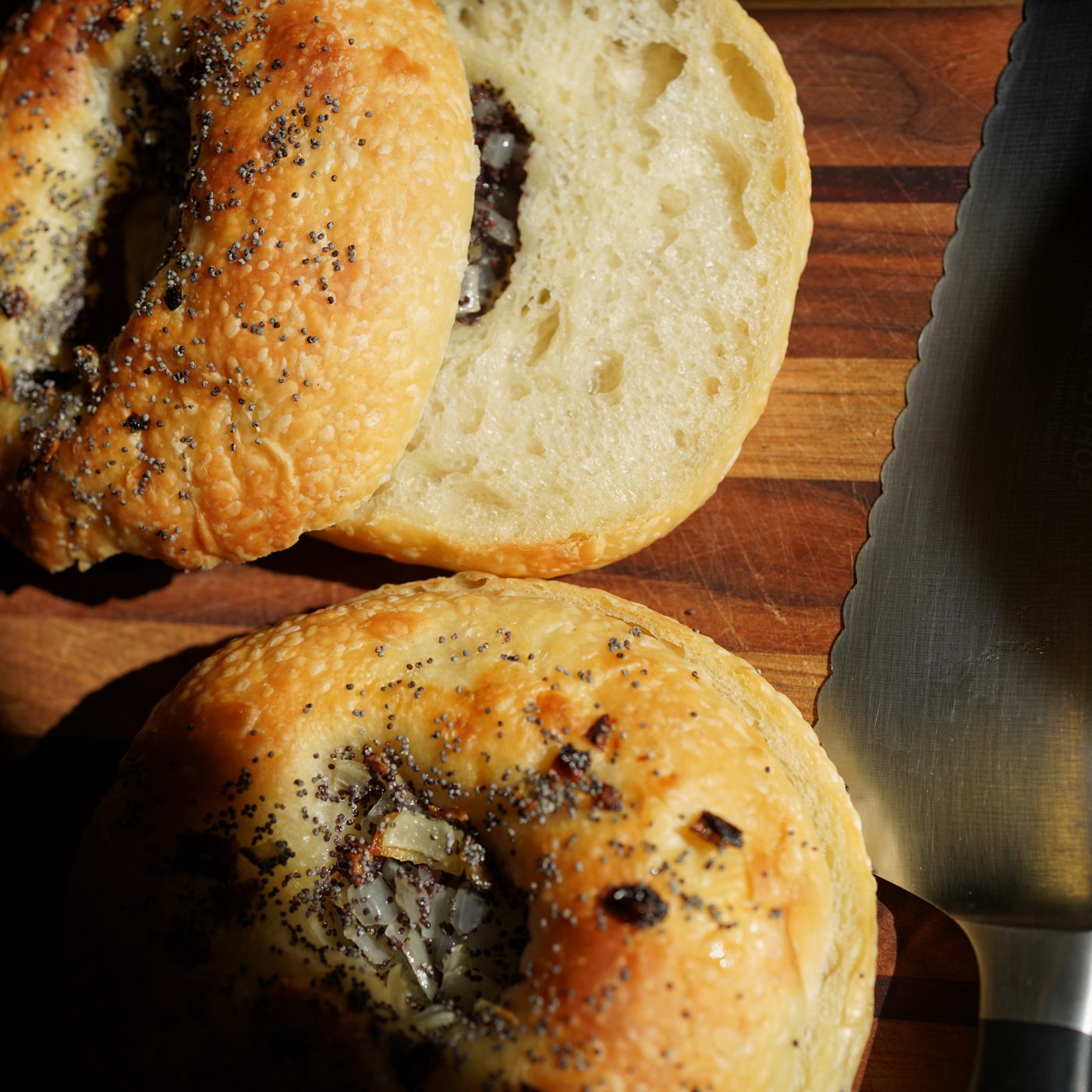
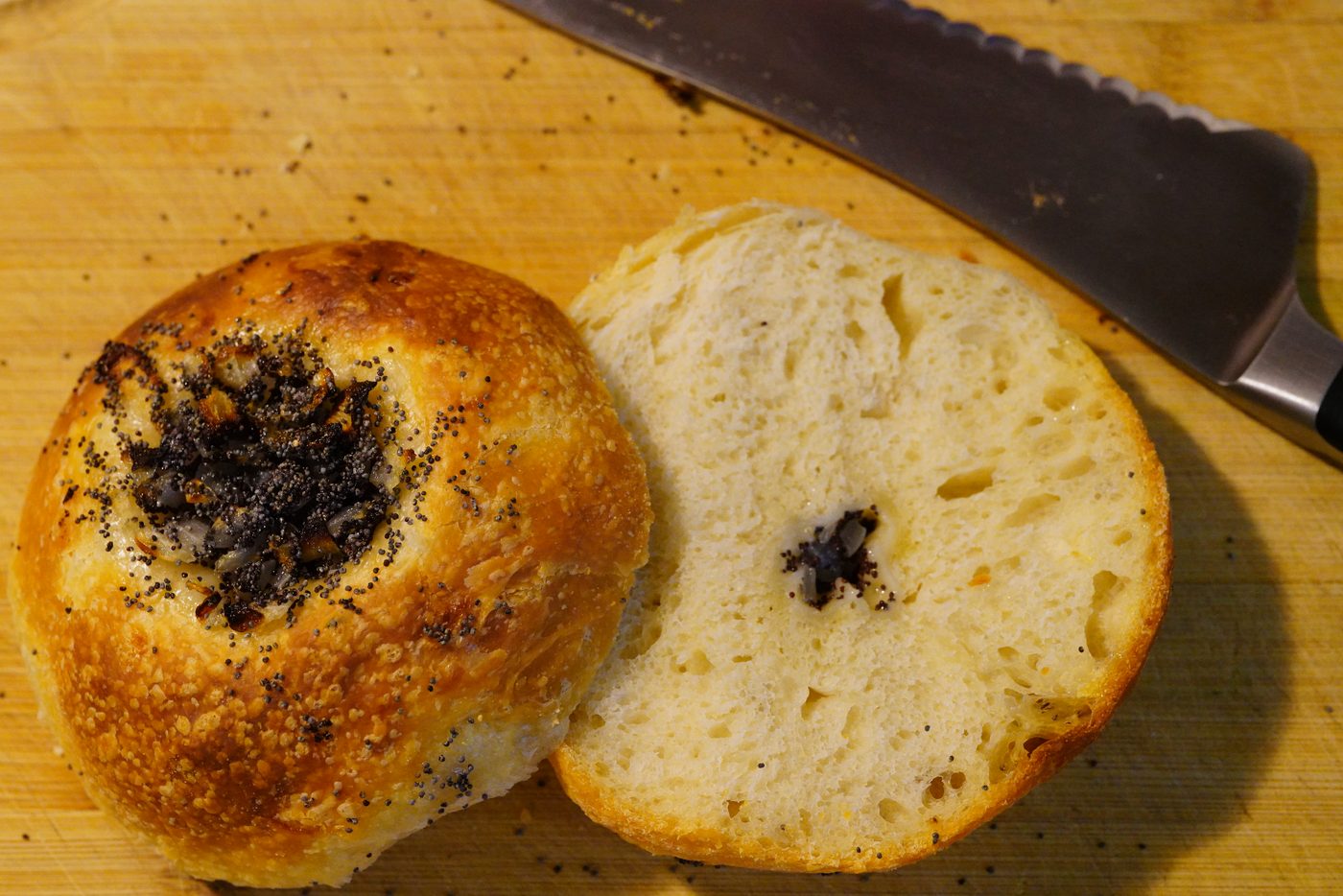
Two bialys on a wooden board beside a bread knife, one split open to show its crumb, the other whole with its center filled with onion and poppy seeds.
Chip, a green leek with big dark eyes, peeking over a bialy.
AlwaysChip

Bialys

(bee-Ahh-leez) sourdough with onion and poppy seeds

Our take on the traditional bialy — shaped by hand, then allowed to proof slowly, rising with the ferment of our sourdough starter, center filled to overflowing with onion and poppy seeds, exactly as we feel it should be. Chewy crust, soft crumb, deep satisfaction, zero shortcuts.

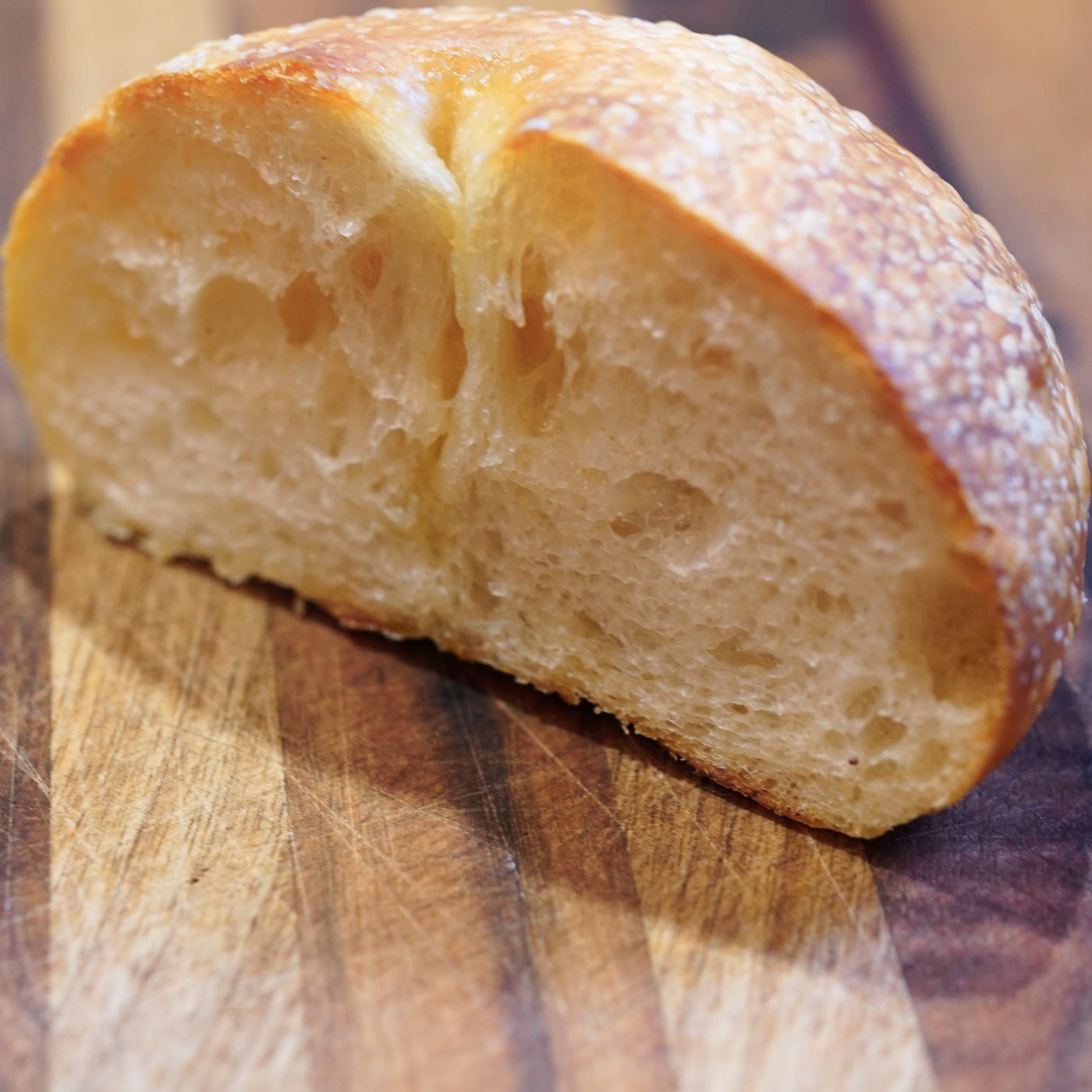
Half a nahly, cut side forward, on a wooden board — a thin, blistered golden crust and an open, glossy crumb, with no seeds or onion.
Sir Robin, a round blue troll in a floppy pink hat, waving with one hand, the other on his bare belly.
UsuallySir Robin

Nahlys

(nah-leez) our bialys — but naked

Say it out loud and (we hope) you'll get the joke: "nah-ly," as in nah to the onions and seeds. Same dough, same hand-shaping and slow proofing as our bialy — just stripped down to the bare essentials. Simple, versatile, and entirely ours. Except we made it for you.

The Small Bites monogram, a looping hand-drawn letter B in black on a purple circle, centered on a cream background.
Usually

Whimsy

a nahly, plus whatever we're feeling today

One nahly, sold on its own and topped or filled with whatever we're feeling that morning. It changes from day to day, at the baker's whim. Today's toppings are written on the label; tomorrow's are anybody's guess.

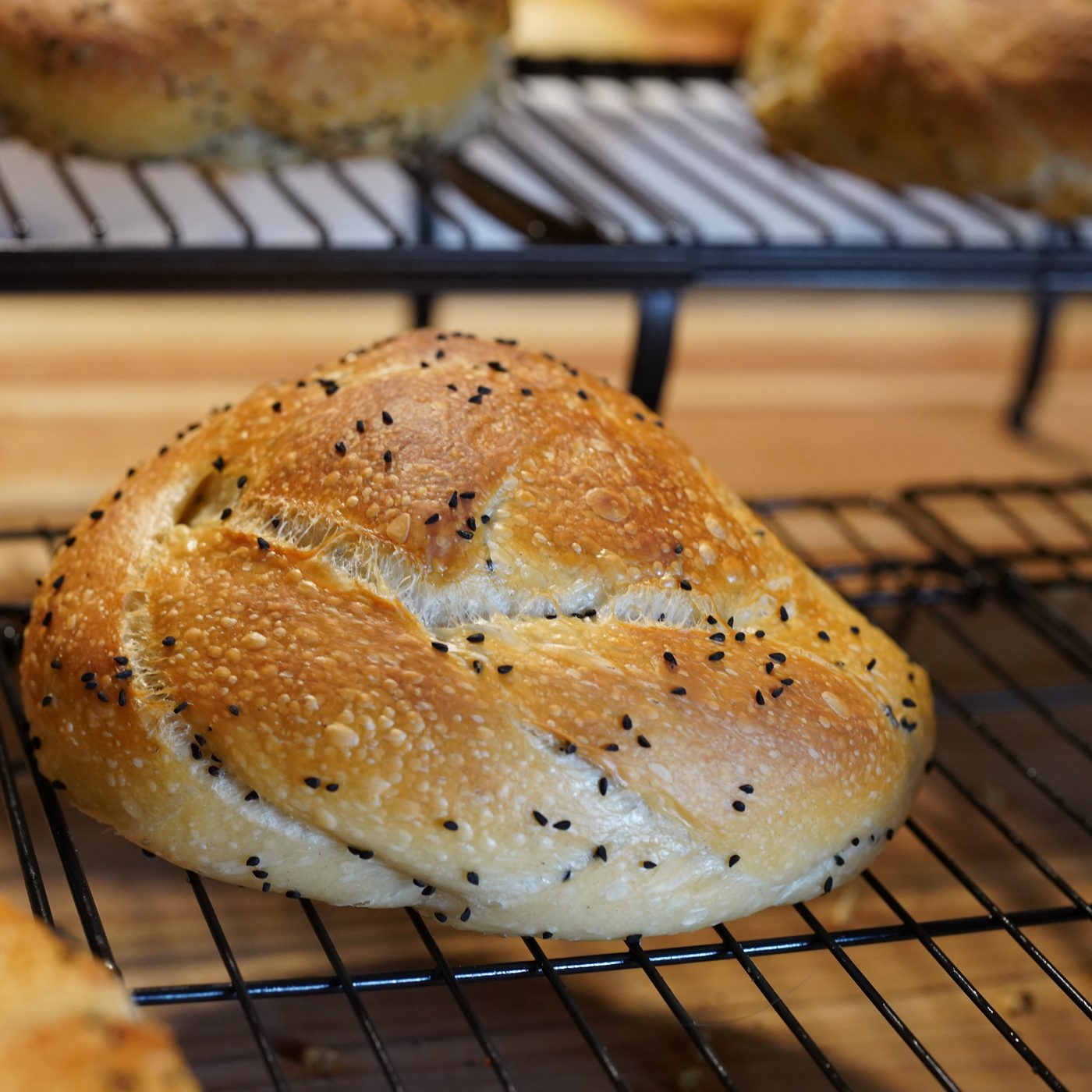
A Skally on a wire cooling rack, a golden braided loaf scattered with black nigella seeds, seeded rolls out of focus behind it.
A braided knot drawn in soft grey shading, standing inside a brick oven arch.
Usually

Skally

(skah-lee) soft seeded sourdough

A soft sourdough loaf, braided by hand from three strands and finished with nigella seeds. Skally is a nod to the braided loaves that came before it, and its own bread entirely. Same dough and long ferment as our bialys — just gentler. For toast, for sandwiches, for tearing at the table.

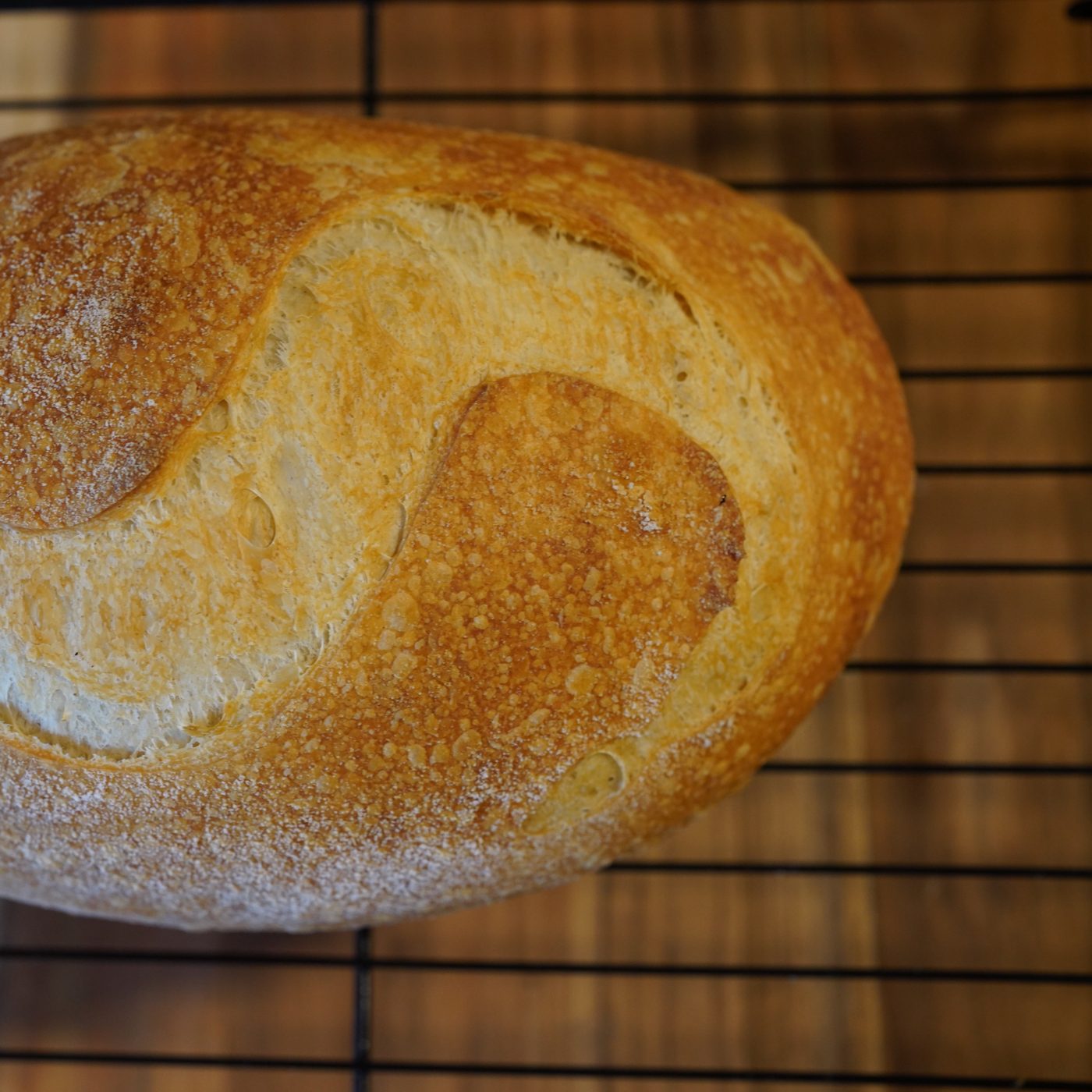
A Big Sammy loaf seen from above on a black wire cooling rack, its flour-dusted golden crust opened along a curving score.
Big Sammy, a fluffy blue cat curled up asleep, one eye half open.
UsuallyBig Sammy

Big Sammy

big soft sourdough

A big, soft sourdough loaf from the same dough and long ferment as our bialys and nahlys, baked larger and gentler. Made for sandwiches and for toast (French or otherwise), and for anyone who wants all of the sourdough flavor with none of the crust that shreds your face.

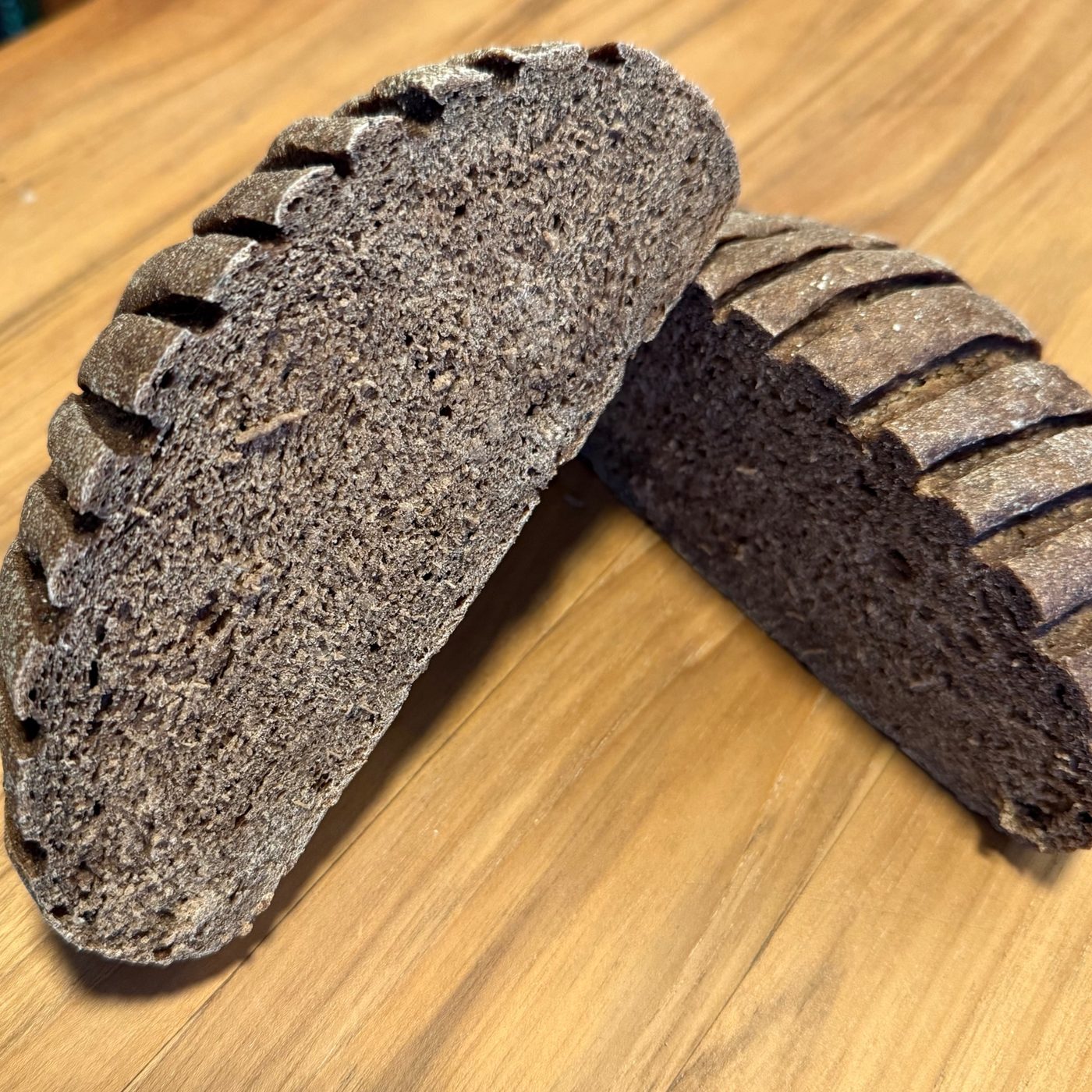
A round loaf of Serious Balt cut in half, the two halves leaning together on a wooden table to show a dense, dark brown crumb under a deeply scored crust.
Serious Balt, a stern man with wild black hair, arched brows, a moustache and a pointed beard, drawn in black and grey inside a round medallion.
Now and thenSerious Balt

Serious Balt

dark rye sourdough with malt and cacao

Our duona — Lithuanian for bread — inspired by the legendary black breads of the Baltic. Whole-grain rye, whole wheat, cracked barley malt, rye malt and pure cacao, raised on Barney, our rye starter, with a little more wheat than the originals. Intense, dark and very serious: the perfect vehicle for smoked meats, cured fish, cheese… or anything pickled, really. Try it fried.

How a bialy comes together

01

Mix

Flour, water, sea salt, and a spoonful of Betty, our ten-year-old sourdough starter, brought together by hand, nothing rushed.

02

Rest

Slow fermentation gives the dough its flavor and open, chewy crumb.

03

Shape

Each round is hand-pressed into its signature center, never punched through like a bagel.

04

Proof

Shaped rounds rest once more, until they've aged, a bit, and risen, ready for a hot oven.

05

Bake

A hot, fast bake for color and crust, then straight to your local grocer.

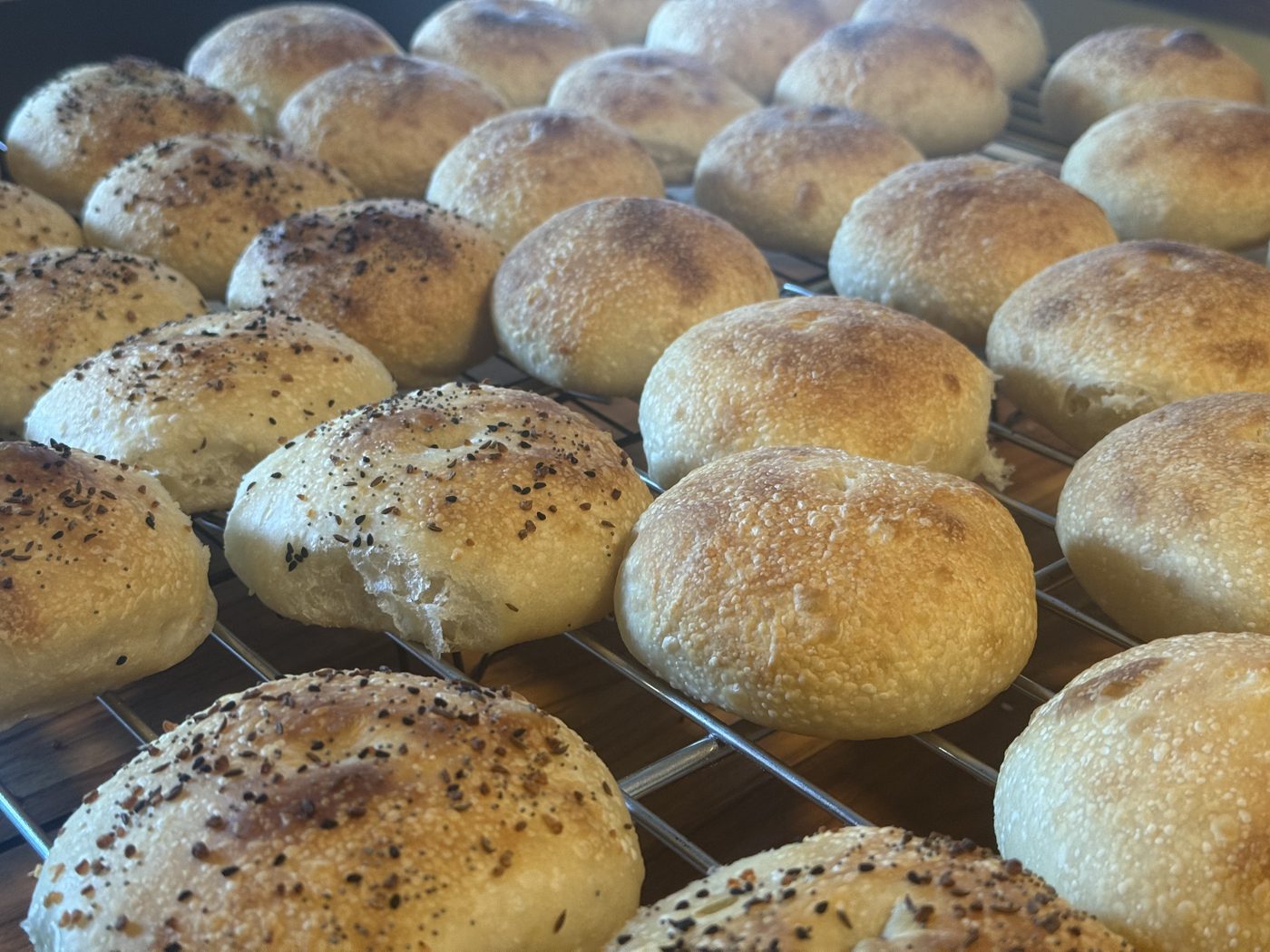
A finished batch of bialys and nahlys cooling on a rack

A batch fresh out of the oven, cooling before they head to the grocer.

At your table

Serving suggestions.

Pictures of the breads we bake, food we made or things we ate, all photographs by Jonathan.

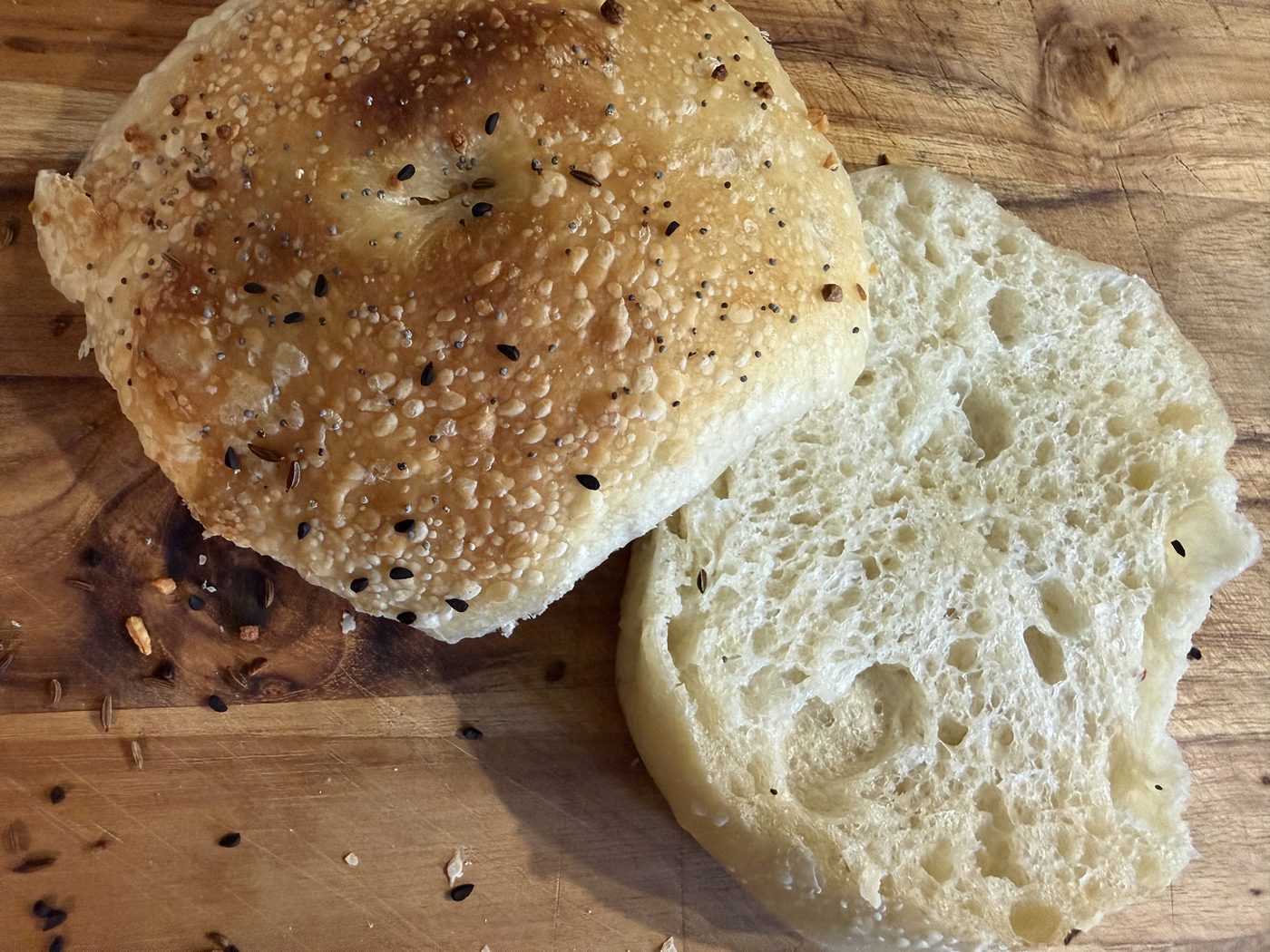
A split sourdough roll on a wooden board, its top crust blistered, golden and scattered with seeds, the cut half beside it showing a very open, airy crumb.
Our sourdough breads bring all the chewy flavor and crust without any fuss, use them for a nosh, pile on the BBQ or build a muffuletta, our rolls are up to the challenge of making your favorite sammy even better.
A bialy split in half on a wooden board, the filled centre of onion and poppy seeds on one half and the open crumb of the cut face on the other, a bread knife alongside.
Want to keep all that onion and poppy goodness? Slice it lengthwise and scoop the loose filling onto the bottom half before building your sandwich!
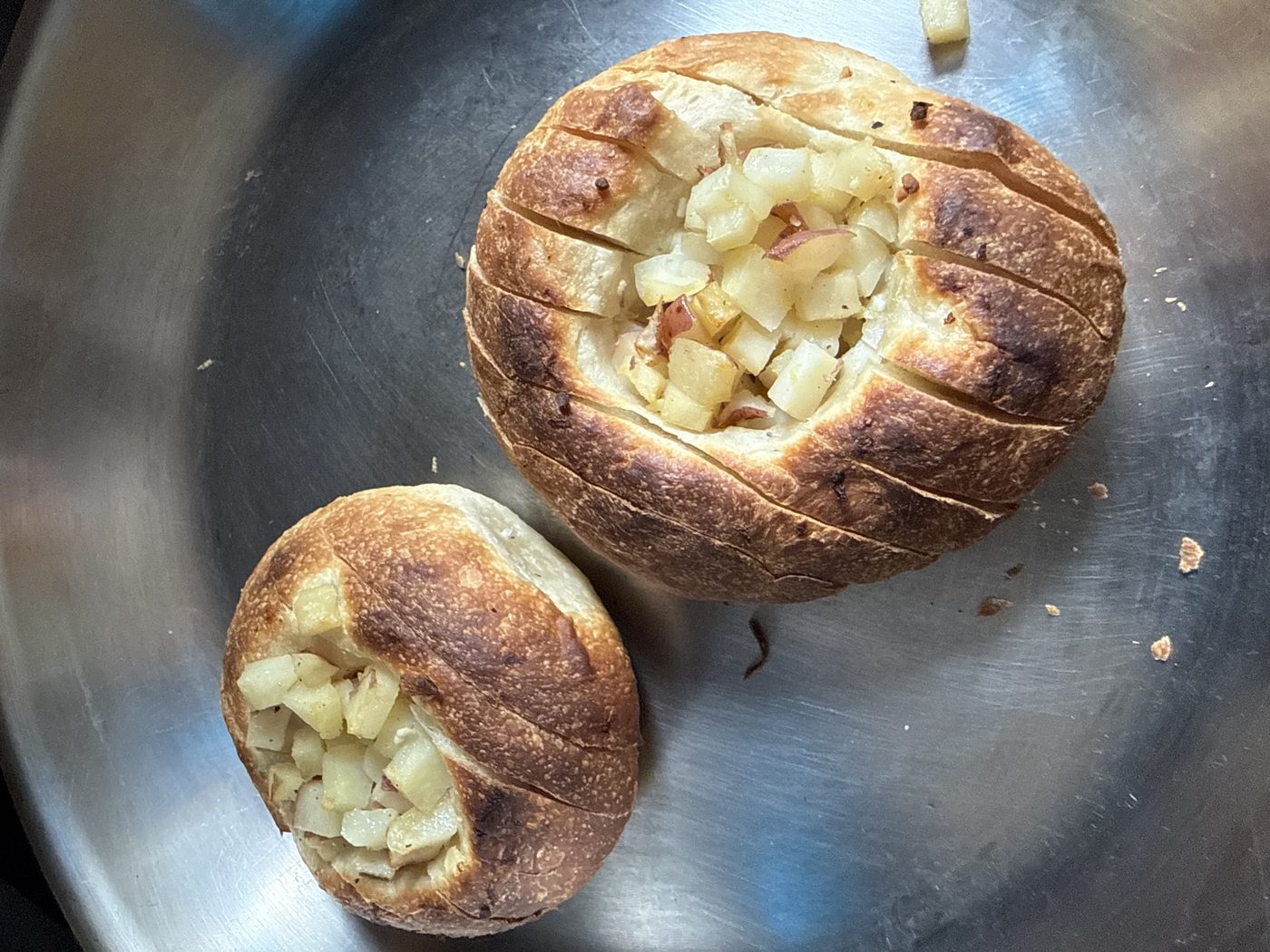
Two small round loaves in a steel pan, each scored across the top like a Hasselback potato, with diced potato and onion tucked into the cuts.
We are always down to try something new around here, maybe you too will get a chance to try the Hasselback bialy sometime soon. It was one of our better inspirations!
Find us

Currently available at one local grocer.

We're just getting started, and we like it that way — small batches, sold close to home. Here's where to find Small Bites this week.

Fresh bread arrives six mornings a week — no bread on Mondays — and is usually on the shelf by 10 or 11 a.m. Most days we sell out, so earlier is better.

Now in stock

Golden Harvest

47 State Rd, Kittery, ME 03904

Get in touch

Questions, wholesale inquiries, or just want to say hi?

We don't use social media, so this is the best way to reach us directly.